
From Pharaohs to Souvenirs: Inside Egypt’s Papyrus Workshops
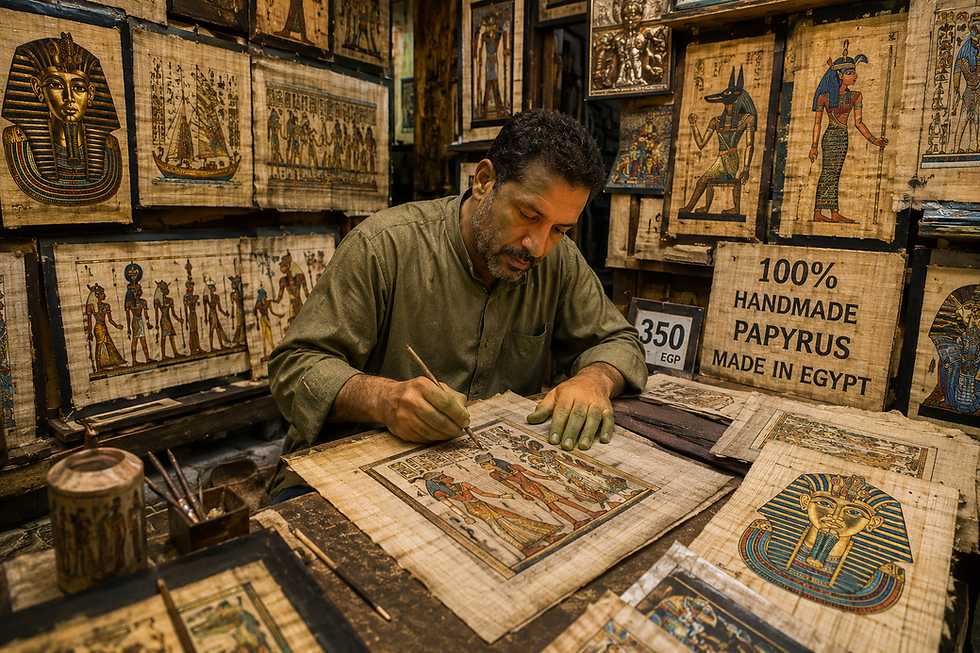
In the narrow, stone-paved alleys of Cairo’s historic districts, color spills out of small shops long before customers step inside. Sheets of papyrus hang like windows into another time, covered in scenes of pharaohs, gods, and daily life along the Nile. Here, buying and selling is not just a transaction, but a layered exchange between past and present, art and livelihood. Across Egypt, much of this activity unfolds beyond formal markets, in informal spaces where traditional crafts are shaped as much by heritage as by the rhythms of tourism. Among the most visible examples is the papyrus trade, a craft that continues to evolve at the intersection of culture and commerce.
In Al-Muizz Street, Mustafa Mohamed, owner of Sultan Al-Kamel bazaar, describes a business rooted in both tradition and adaptation. “The papyrus in my shop is handmade,” he says, pointing to pieces that range from classic motifs to more modern variations, including designs that glow in the dark. He explains that while Egyptians do buy papyrus, tourists remain the main customers, shaping both demand and design.
Mohamed adds that the trade provides a steady source of income, operating throughout the year without a fixed season. Prices typically stand at around 350 EGP but can drop to 250 EGP when customers purchase more than one piece. “Papyrus is one of the most popular items among tourists,” Mohamed says, noting that many foreign buyers arrive with prior knowledge and a clear appreciation of its artistic value, even as they engage in the familiar ritual of bargaining.
From a different perspective, Dr. Karam Hanish, professor of drawing and painting at Helwan University, situates today’s papyrus production within a broader artistic context. “They are based on copied elements from ancient Egyptian art,” he explains, referring to most contemporary papyrus works. He notes that these pieces are often produced using simplified coloring techniques, prioritizing visual appeal and recognizability over originality.
Hanish emphasized that this represents a shift from the depth of ancient Egyptian art, which historically included complex religious, social, and funerary narratives embedded with symbolic meaning. “Ancient Egyptian art was more complex,” he says, pointing to the layers of storytelling and symbolism that defined original works.
Hanish also links this transformation directly to tourist behavior and expectations. “Today’s tourists are mainly looking for symbolic souvenirs, not detailed historical knowledge,” he explains. As a result, papyrus has gradually moved from being a deeply expressive art form to a commercial product shaped by demand, where accessibility and familiarity often take precedence over artistic innovation.
In this evolving space, papyrus stands as both artifact and commodity, carrying fragments of Egypt’s past while adapting to the realities of its present economy.