
From Wekalet El Ghouri .. Tanoura: Spinning Between Earth and Sky
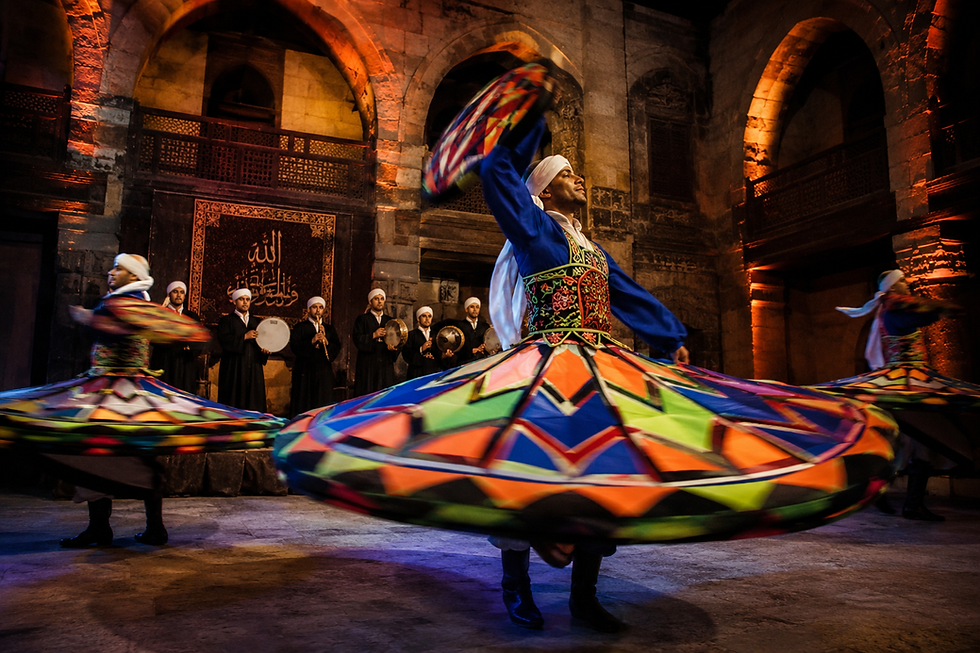
Inside the historic halls of Wekalet El Ghouri, silence settles briefly over the audience before the sound of the flute slowly rises through the centuries-old architecture. Beneath dim lights and carved stone walls, performers dressed in brightly colored skirts begin to move in circles, transforming the stage into something between ritual, performance and spiritual meditation.
For many visitors, the Tanoura show appears to be a cultural attraction. But for its performers, the dance represents something far deeper: a living expression of Egyptian heritage rooted in rhythm, spirituality and collective memory.
The Tanoura Heritage Troupe was established in 1988 under Egypt’s Ministry of Culture. Yet according to artistic director Mohamed Salah, the performance itself belongs to traditions far older than any institution.
“We are an expression of our heritage,” Salah says. “The current developments in creative work do not concern us.” Unlike many formal performance groups, the troupe’s musicians are rarely academically trained. Salah explains that nearly 90 percent of the performers never studied music professionally. “They do not learn music,” he says. “They feel it.”
The performance begins with an improvised musical section known as “Tahlaa,” during which each musician performs individually using traditional instruments such as the flute, daf, tabla and cymbals. Gradually, the separate sounds merge into a single rhythmic pulse that fills the space.
As the performance transitions into its Sufi-inspired section, the Tanoura costume itself becomes symbolic. The dancers’ spinning movements reflect spiritual ideas of harmony, surrender and connection between the human body and the universe.
One dancer moves at the center while others orbit around him, symbolizing planets revolving around the sun. The circular motion represents the relationship between Earth and sky, while repeated religious chants echo through the hall: “Allah, Allah… Ya Rasoul Allah.”
Even audience members unfamiliar with Arabic often understand the emotional language of the performance through movement alone. As the rhythm intensifies, the atmosphere changes dramatically. The meditative pace gives way to celebration as colors blur through rapid spinning and increasingly complex choreography.
The final section becomes a test of endurance and control. The dancers no longer simply rotate; they manipulate massive layered skirts while maintaining balance through continuous spinning that can last for extended periods without pause.
For performer Mazen Mostafa, Tanoura has shaped nearly his entire life. Mostafa began spinning at the age of seven, following in his father’s footsteps through neighborhood performances and local folk groups before eventually joining professional stages. “The first time I wore the Tanoura felt completely different,” Mostafa recalls. “But I was not yet fully connected to the rhythm.” After more than fifteen years of performing, Mostafa says spinning has become a personal language through which he expresses emotion. “When I am upset, I express it through spinning,” he says. “Sometimes my best performances happen when I am angry or joyful.”
Despite its graceful appearance, Tanoura requires intense physical endurance and constant training. Mostafa describes it as one of the most physically demanding folk performances in Egypt. One of his most difficult experiences occurred during a live performance. “I was spinning very quickly and strongly when I felt my leg snap,” Mostafa says. “I continued performing until I left the stage, then discovered my leg was broken.”
Alongside the dancers, religious singer Gamil Gamal provides what performers describe as the “voice” of the experience. Coming from a family of religious singers, Gamal has performed with the troupe since 2000, guiding audiences through chants and rhythms that connect the spiritual and musical elements of the show.
Although Tanoura performances have become closely associated with tourism in Cairo, performers insist the tradition remains rooted in something much older than entertainment alone. For the performers, Tanoura is not simply a spectacle. It is an act of preservation, emotional release and collective connection.
Inside Wekalet El Ghouri, the spinning never truly feels like movement toward an ending. Instead, it feels cyclical, repeating the same rhythms that have echoed through generations, carrying heritage forward one rotation at a time.