
Pink or Blue? Inside Egypt’s Gender Reveal Trend
When Egyptian actress Laila Ahmed Zaher appeared in a pink dress to announce she was expecting a baby girl with Hisham Gamal, the moment quickly turned into more than a family celebration. The reveal dominated social media conversations and showed how gender reveal parties in Egypt have become carefully staged public moments, where personal joy, celebrity branding, and online engagement often meet. From cakes filled with colored cream to smoke bombs exploding in front of the pyramids, gender reveal parties have transformed from intimate family moments into one of social media’s fastest-growing trends in Egypt. What once began as a small celebration between parents now blends entertainment, marketing, and online performance, especially when celebrities are involved.
According to Mayar Mohamed, an event planner who specializes in gender reveal setups, social media has become impossible to separate from the phenomenon. She said celebrity reveals are often planned as public announcements rather than real moments of discovery. “They were announcing it to the public, not discovering it themselves,” Mohamed said, referring to Zaher and Gamal’s reveal. “The pink dress created massive attention for the designer and the video itself.”
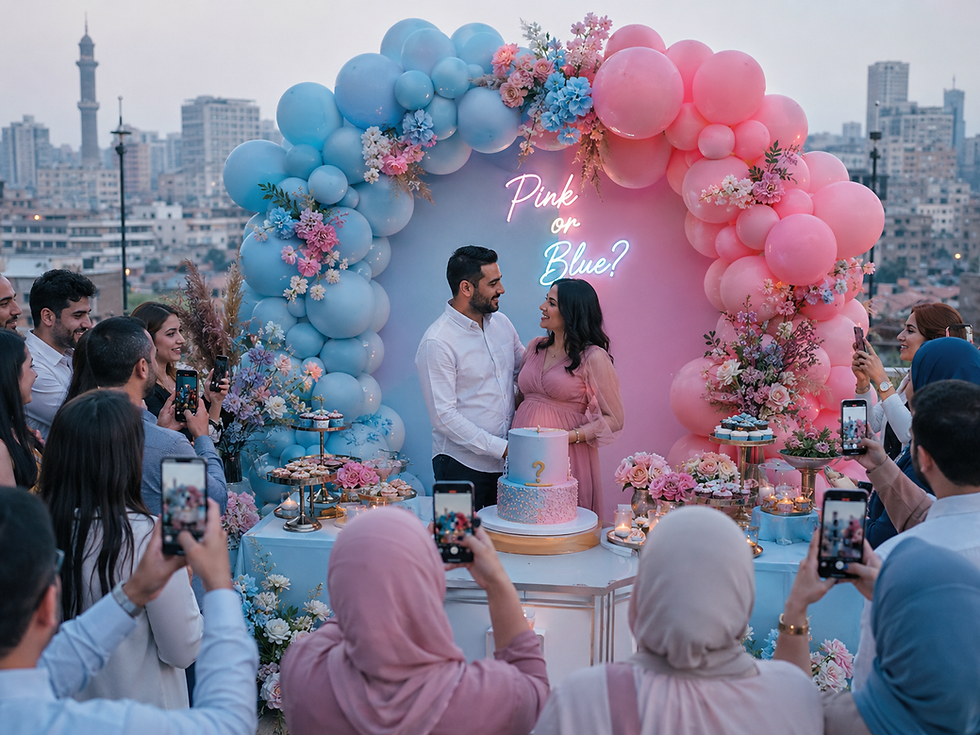
Mohamed said the most requested setup remains pink and blue decorations with smoke bombs or colored fire extinguishers. The trend, she explained, now cuts across social classes, from simple celebrations at home to large luxury events in iconic locations such as the pyramids. The idea often remains the same, but the scale changes depending on the budget and how much attention the client wants.
Mohamed traces the trend’s popularity back to around 2015, when gender reveal videos began spreading widely online. “At first, it was just cakes with blue or pink filling,” she said. “Then it evolved into colored powders, paint fights, and dramatic reveals because videos started getting more reach.”
She said the success of this type of content depends largely on curiosity, as viewers often continue watching because they want to know whether the baby is a boy or a girl. “People want to know if the baby is a boy or a girl, so they keep watching until the end,” Mohamed explained. “Even if there’s an advertisement in the middle of the video, viewers stay because they want the answer.”
In celebrity culture, gender reveals are no longer just family celebrations. They have become branding moments. Carefully staged visuals, black-and-white teaser videos, suspenseful editing, and dramatic reveals are often designed to maximize reach and engagement. “The first few seconds of the video are the most important for reach,” Mohamed said. “Everything is planned to keep viewers watching.”
For Aya Ismail, a mother who recently organized a gender reveal for her baby boy, the celebration had a different meaning. She said the event was never about going viral, but about creating a memory her family could return to in the future. “I was really excited for the gender reveal because I wanted it to become a beautiful memory for the future,” Ismail said. “Like wedding videos you watch years later, I wanted my baby to one day see that moment and feel how happy we were.”
Ismail explained that the event was intentionally intimate and limited to family members only. The reveal centered around a cake hiding blue filling inside, followed by balloons filled with colored powder. When the balloons burst, blue powder filled the air, announcing the arrival of a baby boy. Despite the simplicity of the idea, the celebration still cost around 35,000 Egyptian pounds, a figure that reflects how expensive even small-scale reveals have become.
Unlike many online celebrations, Ismail said social media attention was not her motivation. “I wasn’t really focused on Instagram,” she said. “I feel like a lot of people do it now mainly for show-off or to become a trend. For me, it was more about the memory itself.”
As gender reveal parties continue growing in Egypt, the celebrations now sit somewhere between personal memory and public performance. For some parents, they remain emotional family milestones. For others, they have become carefully crafted spectacles designed for clicks, attention, and online visibility. Either way, the question remains the same until the final moment: pink or blue?