
Egypt Secures Health Gateways to Protect Departing Hajj Pilgrims
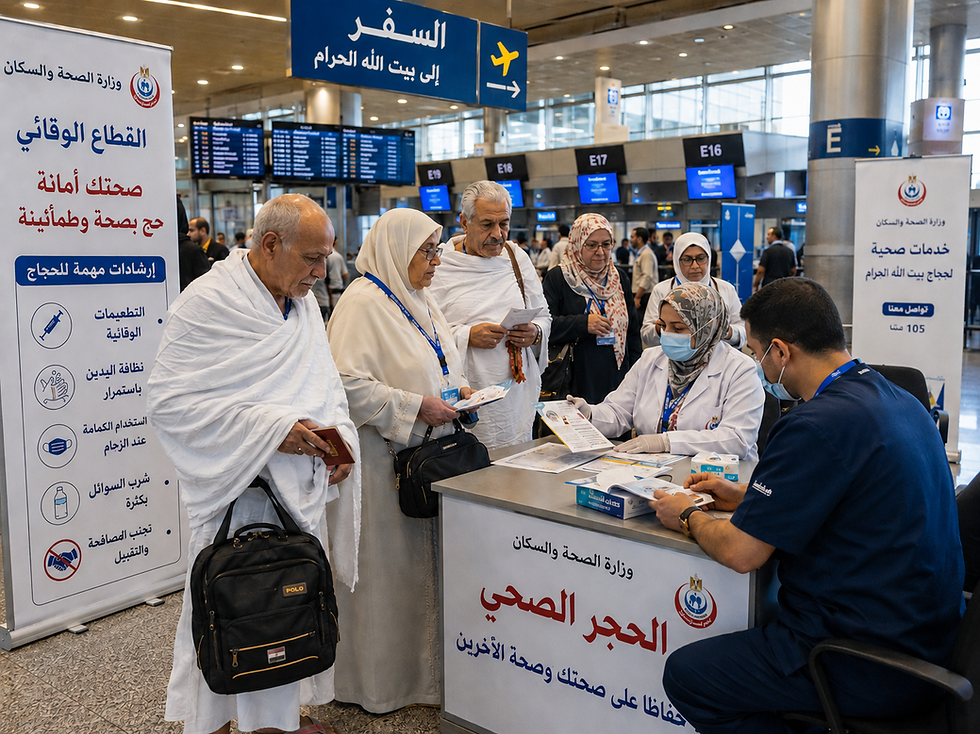
At the busy departure terminals of Cairo and Luxor International Airports, as well as the Nuweiba Sea Port, Egypt’s Ministry of Health and Population has deployed an extensive medical frontline to secure the health of 19,055 departing Egyptian pilgrims. According to the UNFPA Egypt CS Report and recent Ministry statements, these exit ports have been transformed into preventive screening zones where travelers undergo health monitoring before embarking on their spiritual journey to Saudi Arabia. By positioning dedicated medical teams at the nation’s international exit points, the state is actively enforcing strict quarantine protocols, medical screenings, and localized health education to mitigate epidemic risks during the high-density gathering.
The pre-travel operation balances immediate clinical support with long-term preventative awareness. Throughout the departure areas, healthcare teams distributed 4,564 comprehensive health awareness brochures and treated 117 pilgrims through temporary transit clinics and the specialized quarantine clinic located at the Nuweiba Pilgrims’ Village. To supplement the physical screenings, authorities organized 114 educational seminars across regional health units, training travelers. particularly elderly citizens and those living with chronic illnesses, on crowd safety, immediate infection prevention, and the necessity of managing prescribed medications in clearly labeled boxes to maintain physical stability while abroad.
The preventative strategy relies on mandatory immunization requirements designed to withstand the physical stress of the rituals. Dr. Shimaa Hassan, from the Ministry’s Medical Administration, emphasizes that all travelers must present verified vaccination certificates for meningococcal meningitis and seasonal influenza before being cleared for departure. She clarifies that these measures are part of a unified epidemiological defense system designed to block the cross-border transmission of infectious diseases. The accompany awareness campaigns focus heavily on guiding citizens toward designated vaccination centers and mapping out emergency resources available to them in the Holy Lands.
The high-density nature of the gathering presents unique physiological challenges, specifically extreme heat exhaustion, sunstroke, and sudden blood pressure spikes. Medical teams on the ground are instructing pilgrims to wear lightweight cotton ‘Ihram’ clothing to reduce thermal stress, avoid direct midday sun exposure, and drink fluids continuously during the exhausting circuits of Tawaf and Sa'i. Pilgrim Ahmed Diaa, preparing to board his flight, noted that the family health unit seminars radically altered his preparation, prompting him to restructure his health routine, carry a surplus of chronic disease medications, and strictly follow hydration protocols.
Managing the massive surge of travelers has demanded seamless operational synchronization between health authorities and aviation personnel. Youssef Akram, a Station Traffic Agent at Cairo International Airport, explains that departure halls have been reinforced by port coordinators, security teams, and supplemental airline staff recalled from seasonal leave to clear transit bottlenecks. In addition to securing baggage and flight schedules, airport workers are actively co-distributing emergency health guidelines to ensure that patients with chronic conditions understand how to navigate medical emergencies mid-flight or upon arrival, cementing Egypt’s exit gateways as absolute fortresses of health security.