
Rafah border’s Palestinian door: where foreign policy becomes physical
Updated: Mar 8
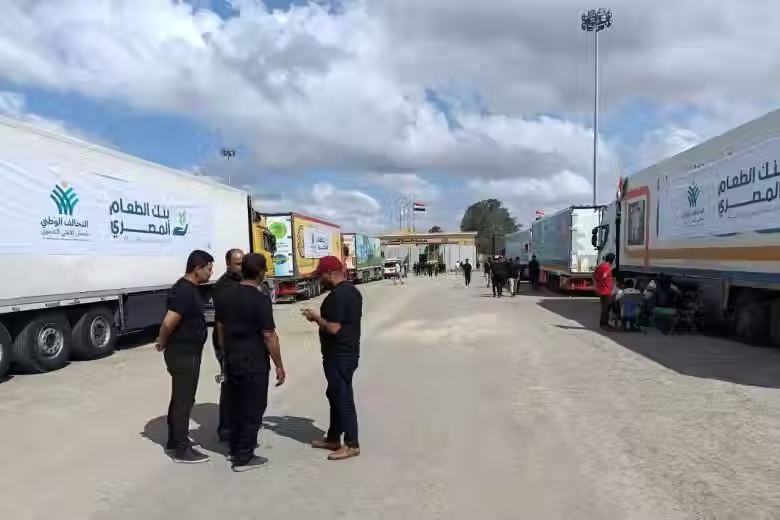
Rafah is not just a border crossing. It is a waiting chamber where foreign policy stops being abstract, and turns into bodies standing still, trucks stopped at the gates, and time suspended.
At Rafah, politics is measured not in statements or press conferences, but in the shuffling of anxious feet on dusty asphalt, in the murmurs of families clutching fragile papers, in the hum of diesel engines turning over as humanitarian trucks await clearance. Each moment stretches, heavy with anticipation and uncertainty.
Taghreed El-Khodary, who has crossed into Egypt multiple times, recalls the gate as more than a checkpoint. “Rafah crossing, for me and for all people of Gaza, means freedom of movement,” she says. “It is the only way we can travel, receive medical treatment, or study abroad.” Entering Egypt through Rafah shaped her future “Without Rafah, I would not have been able to leave Gaza or continue my education overseas.”
The crossing itself turns policy into tangible experience. Under blockade, Rafah is the sole gateway that does not require Israeli permits. Students, patients, and businesspeople all depend on this single door. Every opening and closing, every inspection and delay, transforms political decisions into real, lived consequences.
“Israel is the main controller of the crossing, and this is the reason behind all the problems,” Taghreed explains. Yet she sees a growing awareness abroad as “People now understand that Rafah is the only exit, and they understand the blockade more clearly.”
Ahmed Gebriel, representing Mersal, which coordinates humanitarian aid through Rafah, describes the crossing as a symbol of resilience. “Rafah is the only entry point for aid into Gaza. It represents the perseverance of Palestinians and the cooperation between Egyptians and Palestinians,” he says. But even aid is hostage to politics as when trucks move, which supplies are accepted, and how long they are held, all are dictated by decisions beyond the gate. Hundreds of trucks line the crossing, yet even these convoys, organized by the Egyptian Red Crescent and the National Alliance, cannot meet the needs of a population under continuous siege. “Despite these efforts, the aid is still not enough for a population living under continuous blockade,” Ahmed states.
For those entering Egypt, Rafah is existential. El-Khodary emphasizes Egypt’s crucial stance against forced displacement, saying “I am grateful that Egypt refused the idea of relocating Palestinians and has remained firm on its position,” she says. “Rafah represents how Gaza remains alive, part of a future Palestinian state, and a place where people can still live, even if temporarily, beyond the blockade.”
Every inch of Rafah tells a story. The gates are heavy, the lines long, the voices silenced yet insistent. The heat of the sun, the dust in the air, the metallic clang of trucks, these are the tangible marks of policy made human. Here, foreign decisions are not theoretical; they are waiting in the bodies of children, in the hands of mothers, in the shoulders of the elderly. Every crossing into Egypt carries relief, fear, hope, and impatience.