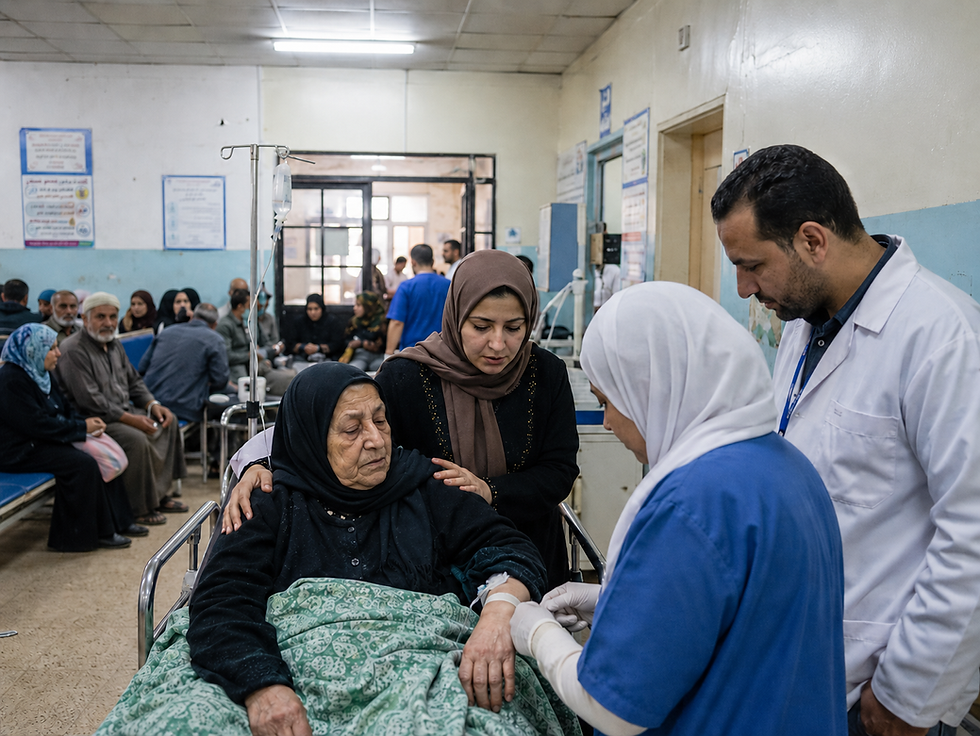

The Healing Chair: A Tale of Swallowing the Pain of Millions
Updated: Mar 8

The Journey of the Chair That Witnessed the Virus's Defeat and Patients' Triumph
In the corner of every liver treatment center in Egypt lies a silent hero, the sole witness to patients’ groans and cries of triumph.
It is the injection chair: not merely a medical seat, but the starting point from which countless health journeys began. Here, where the scent of disinfectants mingled with the scent of hope, we tell the story of places that embraced the suffering of millions and transformed into sanctuaries of recovery.
Dr. Azza Emam. Professor of Hepatology recalls lasting memories of the chair. She believes the treatment centers were not merely buildings, but psychological “operating rooms.” She says, “Initially, the chair was a place of suffering; the interferon sessions were long, the results uncertain, and weakness was etched on patients’ faces as they sat in it. But with the launch of the presidential initiative and the introduction of new treatments, this chair transformed from an immune system ‘guillotine’ into a ‘launching pad’ toward a new life.
She added that she personally witnessed firsthand how the atmosphere of this place changed from cold and intimidating to warm and reassuring.
For his part, Dr. Omar El-Sayed, a specialist in Internal Medicine, witnessed the disease’s trajectory from “chaos” to “organization.” He explains that the reasons for the disease’s spread in Egypt were rooted in simple yet deadly practices: “The disease was spreading like wildfire due to a lack of awareness regarding proper handling of personal items, the practices of barbers, and even within some medical circles before stricter controls were implemented. A single syringe or unsterilized instrument could transmit the virus to an entire family.”
But this place, which had witnessed so much suffering, was transformed by a political decision into a national operations center. El-sayed emphasizes, “The state created a comprehensive system of screening, diagnosis, and free treatment in every village, which broke down the barrier of fear among citizens.”
Looking toward the future, he expressed confidence based on the numbers: “We are moving steadily toward declaring Egypt completely free of Hepatitis C by 2030, so that our experience becomes a model to be studied worldwide.”
For Mamdouh Saeed, a patient living with Hepatitis C, the injection chair was the ‘place’ he dreamed of reaching. Mamdouh explains, “I tried contacting several associations and hospitals to get a treatment chair, but I have been on the waiting list for over four weeks. I was told the hospital’s internet is down, so scheduling an appointment has been difficult. I am trying desperately to get a chair to receive treatment.”
Maha Ibrahim, a recovered patient, recounts with gratitude and a touch of nostalgia how her relationship with the treatment center and fellow patients evolved. She says, “At first, just thinking about going to the center terrified me. I was not feeling comfortable and well at all. But over time, thanks to the medical and psychological care, the center became a meeting place for fellow patients. We sat on those chairs, shared words and hope, and even competed to see who would recover first. That chair also revealed to me the ignorance and fear some people had about the disease, and I saw how people would distance themselves from those infected.”
Today, as Egypt prepares to declare itself completely free of Hepatitis C, these centers, and those chairs, remain historical landmarks. The battle was not just fought in laboratories; it was fought in those small spaces that housed millions of Egyptians, in the hearts and minds of patients.
Egypt has succeeded in transforming “places of pain” into “icons of hope,” ensuring that the injection chair remains in the collective memory, not merely as a medical tool, but as a cornerstone in building the health of a nation that chose recovery from the heart of despair.