
Inside Cairo’s Forgotten Old Bathing Sites "Hammāmāt", Still Breathing with History
Updated: Mar 8
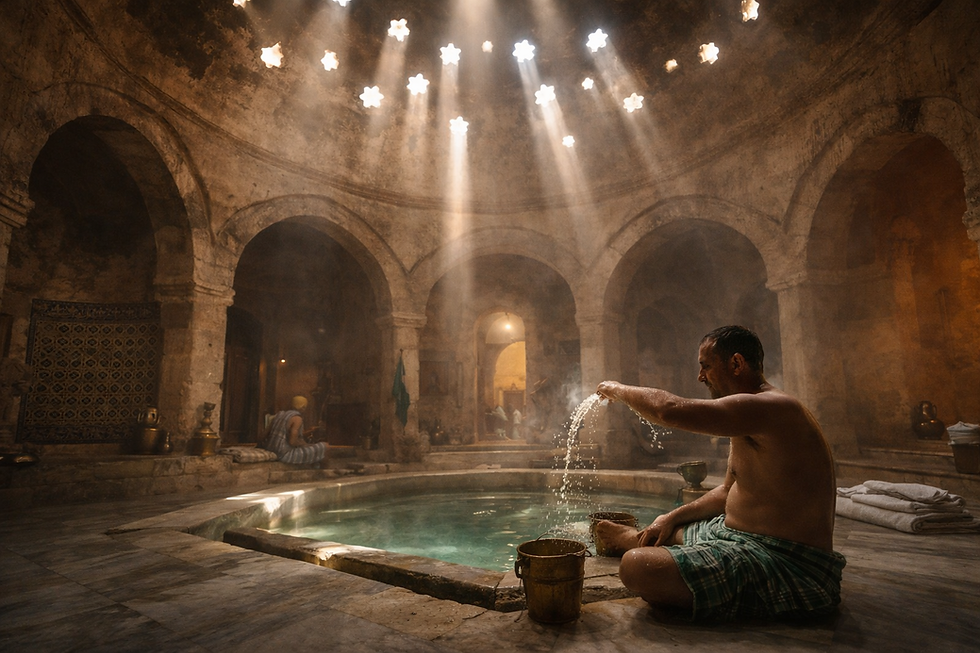
Among the most prominent is Sultan Inal Hammam, located on Al-Moez Street. Built in 1456 during the reign of Sultan Al-Ashraf Abu al-Nasr Saif al-Din Inal, this Circassian Mamluk-era bath remains one of the best-preserved examples of historic hammam architecture in the city.
Dr. Ahmed El-Kholy, Head of the Historic Monuments Preservation Office, explains its design, saying "Sultan Inal Hammam follows the traditional Islamic bathhouse layout, with a cold room for changing, a warm room for relaxation, and a hot room for bathing. This sequence allowed precise control over temperature and an orderly flow for visitors."
He adds, "The domes were designed to let in natural light while also ventilating the space. Floors were sometimes slightly sloped to drain water efficiently, and hot water was channelled from a furnace through a network of clay and metal pipes. This was not just about bathing; it reflected the Mamluks’ attention to infrastructure, social order, and urban planning."
In Sayeda Zeinab, Hammam Al-Malatyli survived well into the 20th century, appearing in Egyptian cinema as a symbol of everyday life and neighborhood intimacy. These hammams were more than bathing spaces; they were stages for stories, gossip, and social bonding.
Laila Youssef, Inspector in Cairo’s Cultural Heritage Department, emphasizes their social role, saying that "For women, the hammam was a center of social life. Visiting before weddings, after childbirth, or during festivals was a ritual connecting generations. Women shared experiences, passed on advice, and built social networks within these walls. Children accompanying their mothers would learn customs naturally, through observation."
She continues, "The hammam also represented a rare space of freedom for women, a chance to step outside the home and engage with their community. Celebrations like pre-wedding henna nights, post-birth visits, and holiday rituals made each visit a complete social experience, combining education, entertainment, and cultural transmission."
As Cairo modernized, public bathhouses gradually fell out of use. Urban development, modern plumbing, and changing lifestyles led many to close, while others deteriorated or were repurposed.
"We are working to document and preserve the remaining hammams," says Youssef. "If they disappear, we lose not only buildings but centuries of social memory. Each hammam tells a story about daily life, rituals, and the social connections that defined Cairo’s neighborhoods."
Today, cultural experts warn that the disappearance of these hammams represents more than the loss of architecture; it marks the fading of a social institution that once shaped Cairo’s communal life. Modern spas may attempt to recreate the hammam experience, but they lack the historical depth, neighborhood intimacy, and ritual significance of the original baths.
El-Kholy concludes, saying "Visiting a hammam today is like stepping into history. It is a chance to connect with the city as our ancestors knew it through community, ritual, and the simple act of shared bathing.