
Khan El-Khalili: Golden Hands Battle Heartless Lasers
In the narrow, winding alleys of Khan el-Khalili, where sunlight dance on polished copper and the scent of incense tells stories of centuries past, a silent war is being waged. It is not a conflict of weapons, but of fingers against machines, and authentic antiques against mass-produced plastic. Here, in the ancient heart of Cairo, the legendary workshops that once filled the world with masterpieces are transforming. This is the story of the places that embraced the secrets of the Pharaohs and Fatimids, now struggling to remain more than just a souvenir display window.
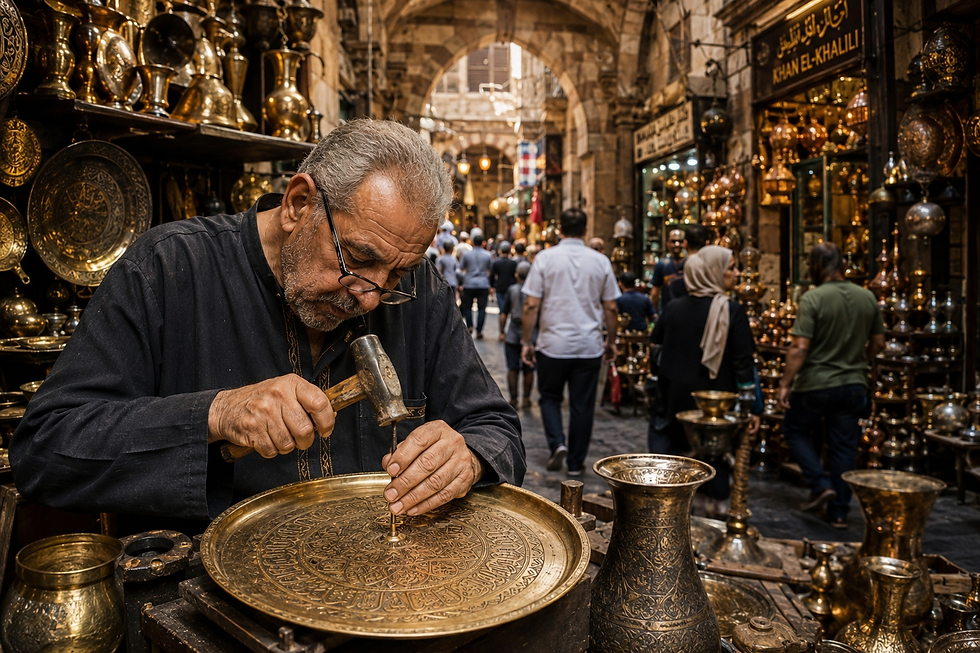
Thirty years of experience have given Haj Mohamed Hassan, owner of Shalby Shop, a perspective on the decline of manual metal engraving. For Hassan, the craft has become a rare relic because of its extreme difficulty, leading many to seek the cold efficiency of modern technology. The writing and decoration on metal by hand is becoming rare, but it hasn’t disappeared, Hassan explains. It is just that it is very difficult, and everyone is taking the easy way out with laser engraving. He notes that while the passion for the craft still exists, the younger generation often lacks the necessary stamina to carry the torch. There are many who want to learn, he says, but the majority no longer have the energy to sit for hours in front of a single piece to finish it.
Despite the encroachment of the machine, a global demand for authentic Egyptian products, such as handmade mother-of-pearl shells and natural leather, provides a thin lifeline for the market. However, Haj Ibrahim Ali, owner of Saheb El-Saada shop, believes the true threat lies in a shift in the merchant’s mindset rather than a lack of interest from buyers. Handicrafts are few, but they haven't died out, Ibrahim asserts. It’s the merchants who are taking the easy way out. But the industry will remain because that is what makes our market unique. He maintains that despite the influx of replicas, the "handmade" label remains the primary attraction for international visitors seeking the soul of Cairo.
While skill and mindset are vital, the rising cost of raw materials remains the silent killer of these traditional practices. The economic reality in 2026 is harsh, putting a heavy strain on the artisans’ ability to produce high-quality goods at a price the market can sustain. Ali notes that while raw materials are still accessible, their soaring prices have become a barrier for local workshops. This financial pressure is forcing many small spaces to scale back, unfortunately making room for cheaper, less authentic alternatives that lack the weight and history of traditional Egyptian craft.
The competition has reached a fever pitch with the dominance of imported goods that mimic the look of traditional crafts but lack their essence. Hassan Samara, an artisan at Beit El-Hana, sees this as a fundamental risk to the identity of the Khan. Customers are always more impressed by handmade items, Samara explains. But if the craftsmen disappear, the Khan will lose its tourist value and become nothing more than a row of glass display cases. He warns that the charm of the area is at risk of being lost forever if it stops being a place of creation and production. If the workshops fall silent, the Khan loses its heartbeat.
Ultimately, the future of Khan el-Khalili depends on whether it can remain a place of creation or simply a place of trade. While the allure of the machine-made path is strong and the economic hurdles are high, the survival of these vanishing crafts depends on honoring the "fingers of gold" that carved Cairo’s history. The soul of the ancient market rests in the hands of those who refuse to let the laser replace the heart.