
Nelson’s Island: Where Ancient Naval Echoes Meet Daily Nets
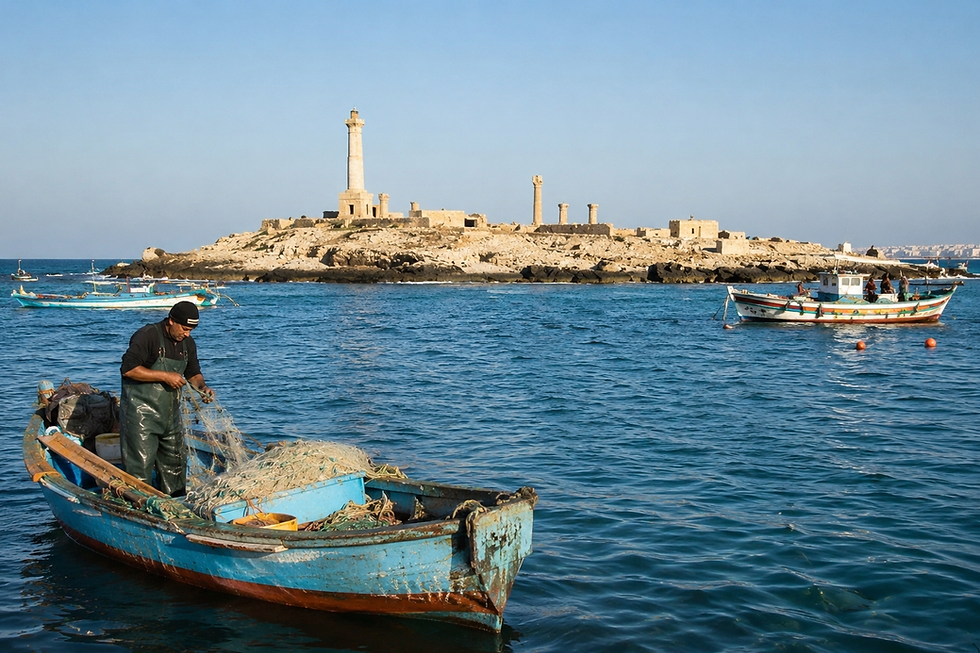
In the heart of Abu Qir Bay, on the northern Mediterranean coast of Alexandria, Egyptian fishermen and international tourists gather daily at Nelson’s Island to bridge the gap between an 18th-century naval defeat and the daily rhythms of modern maritime life. This rocky outcrop, the site of the pivotal 1798 Battle of the Nile, remains a living landmark where the legacy of Napoleon Bonaparte and Horatio Nelson intersects with the local community's search for a livelihood. By preserving its rugged, natural state, the island serves as both a strategic fishing ground and a historical sanctuary, documenting a crucial chapter of Egypt's maritime heritage for every visitor who anchors near its shores.
The island’s rugged nature and its position within active sea currents make it a strategic haven for marine life. For the local fishing community of Alexandria, these currents are the lifeblood of their trade, bringing diverse species to the rocky shores. Yet, the work is a delicate balance with nature. This is a historic island where the Battle of Abu Qir took place, and many tourists still come to visit it, says Hassan Gamal, a local fisherman. His testimony reflects a place where the geography of war has become the geography of sustenance.
Fishing activity in these waters remains a gamble against the elements. Daily yields are dictated by water movement and weather, making the fisherman’s life as unpredictable as the naval battles once fought here. Another fisherman, Sayed Sabry, notes that the island’s allure goes beyond the catch. It is a fishing spot, but people also come here to take photos and enjoy the sea view, he explains. This overlapping use transforms the island into a living gallery where history is viewed through the lens of a modern camera and the mesh of a fishing net.
Despite its significance, Nelson’s Island remains a raw, natural historical site rather than a polished museum. It holds the simple remains of the French campaign, documenting a pivotal moment in global history through its very soil and stone. Dr. Zahi Hawass, the renowned archaeologist, has frequently highlighted the importance of such locations. He emphasizes that sites like Abu Qir are vital for documenting Egypt’s maritime heritage, showing how history and tourism can coexist within a natural landscape.
For men like Hassan and Sayed, the island is a constant companion. They work its perimeter with a practiced respect for its historical and natural character, even as occasional tourist boats anchor nearby. They represent the living bridge between the 1798 wreckage resting beneath the waves and the vibrant, working coast of 2026.
Nelson’s island remains a space where the past refuses to be silenced. It is a landscape where the ghosts of the French fleet share the currents with modern wooden boats, proving that in Egypt, history is never just a memory, it is a workplace, a view, and a way of life that continues to shape the identity of the Mediterranean shore.