
The Electronic Eye of the Kings: When Science Awakened the Pharaohs
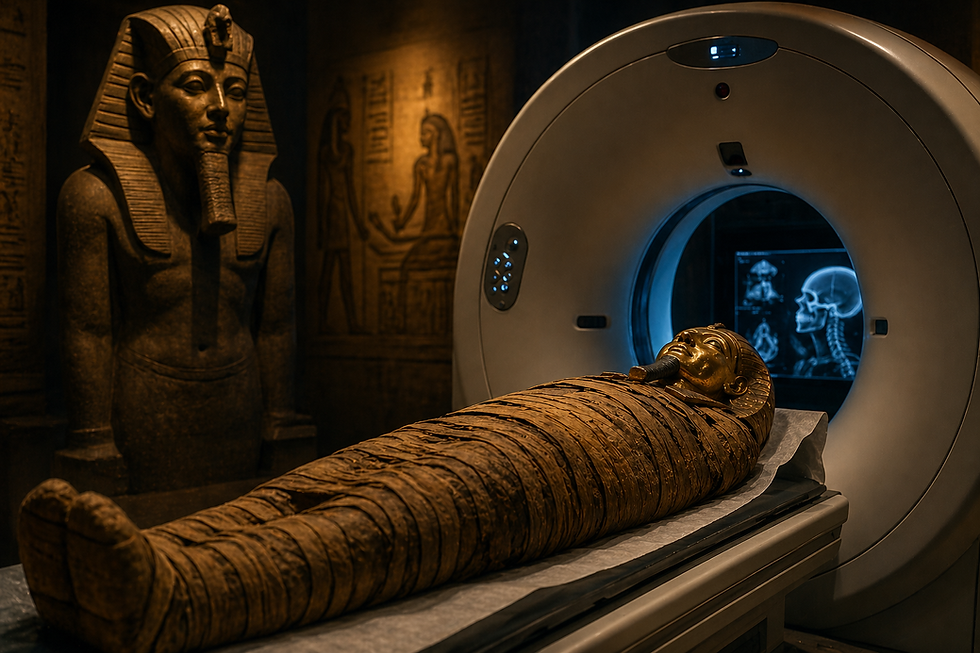
At the heart of the Egyptian Museum’s silent chambers lies a hero of a different kind, one that wears no crown and possesses no papyrus, but rather an eye of light that pierces the scrolls of time. It is the CT scanner, a silent interpreter that serves as a bridge between 21st-century technology and the bodies of kings who ruled the earth thousands of years ago. Within the museum walls, it has transformed the darkness of the sarcophagi into an open book, allowing the world to read the secrets of the dead in awe.
Dr. Islam Ezzat, a Professor of Archaeology at Cairo University, recalls the moment this medical marvel entered the world of antiquity. For him, the scanner was more than a machine; it was a revolution in preservation.
"The CT scanner wasn't just a medical device that entered the museum; it was a highly accurate diagnostic tool that allowed us to examine mummies without touching them," Dr. Ezzat explains. "It ensures the complete preservation of organic remains while allowing us to write accurate ‘death certificates’ for our kings."
He points to King Seqenenre as a primary example. The scans precisely determined the angles of the blows he sustained, revealing his martyrdom in battle, details that would have remained invisible to the naked eye under layers of linen.
For Dr. Eman Nabil, Professor of Archaeology at Ain Shams University, the scanner’s screen is a mirror reflecting the daily realities of ancient Egypt. Through this technology, researchers are no longer just looking at bones; they are witnessing entire life stories.
"We see the diseases that plagued them, cancers, jaw infections, and dental problems," Dr. Nabil notes. "It goes beyond imagery; the device helped us build a digital family tree, linking kings to their families through forensic analysis. It provides conclusive scientific evidence that these kings are our direct Egyptian ancestors, silencing any claims to the contrary."
Perhaps the most dramatic moment in the scanner’s museum career was witnessed by Dr. Zahi Hawass, former Minister of Antiquities. He recounts the "rebirth" of King Seqenenre Tao II, a mummy that had remained a mystery for centuries because researchers feared unwrapping its fragile linen.
"Thanks to the CT scanner, we were able to perform a ‘virtual unwrapping,’" Hawass says. "We saw the king's face for the first time in thousands of years. We saw everything with perfect clarity while the mummy remained safely in its place, protected from any danger."
Today, the CT scanner stands as a permanent fixture in the museum, a symbol of the "Egyptian mind" that created civilization in antiquity and now employs the height of modern medicine to preserve it. It is no longer just a diagnostic tool for the living; it is the faithful guardian of history, ensuring that the pharaohs live on, not just through their mummified remains, but through the scientific truths they continue to tell the world.